
Greenville County Circuit Court Overview
The Circuit Court is South Carolina's court of general jurisdiction. It hears the broadest range of cases. The court is split into two parts. The Court of Common Pleas handles civil matters such as lawsuits, foreclosures, and money judgments. The Court of General Sessions handles criminal matters such as felonies and serious misdemeanors. Both sides keep their files through the same Clerk of Court. The Greenville County Circuit Court also has limited power to hear appeals from the lower courts, which means it reviews some decisions from Probate Court, Magistrate Court, and Municipal Court.
Greenville County sits in the Thirteenth Judicial Circuit. The 13th Circuit covers two counties, Greenville and neighboring Pickens. Circuit judges rotate through the courts in the circuit and hear cases in each county. The South Carolina Judicial Branch gives a clear picture of what the trial court does on its Circuit Court overview page. That page confirms the split between Common Pleas and General Sessions.
The state page above describes the Circuit Court as the trial court with the widest reach. It is the starting point when you are not sure whether a case is civil or criminal.
Greenville County Court List and Locations
Greenville County court business is spread across the county, not held in one building. The Circuit Court sits downtown. The summary courts, the municipal courts, and the bond court are each in their own spot. The table below pulls the main trial and summary courts together with their address and phone, so you can see where each type of case is heard. Civil and felony matters point downtown. Small claims, evictions, and county traffic point to a summary court.
| Court | Address | Phone | Notes |
|---|---|---|---|
| Greenville County Courthouse / Circuit Court | 305 E. North Street, Greenville, SC 29601 | 864-467-8551 | Common Pleas and General Sessions; Clerk of Court. |
| Greenville Family Court Courthouse | 350 Halton Road, Greenville, SC 29607 | 864-467-5800 | Domestic, juvenile, adoption, custody, support, divorce. |
| Greenville County Probate Court | 301 University Ridge, Suite N-T100, Greenville, SC 29601 | 864-467-7170 | Estates, guardianships, marriage licenses, commitments. |
| Master-in-Equity | 305 E. North St., Suite 313, Greenville, SC 29601 | 864-467-8556 | Equity, foreclosure, and referred civil matters. |
| Bond Court / City Magistrate | 4 McGee Street, Room 116B, Greenville, SC 29601 | 864-467-5312 | Bond hearings, warrants, initial appearances. |
| Gantt Summary Court | 1103 White Horse Road, Greenville, SC 29605 | 864-467-8825 | Magistrate / summary court. |
| West Greenville Summary Court | 301 University Ridge, S-T600, Greenville, SC 29601 | 864-467-4640 | Magistrate / summary court. |
| North Greenville Summary Court | 301 Trailblazer Drive, Travelers Rest, SC 29690 | 864-467-8600 | Magistrate / summary court. |
| South Greenville Summary Court | 445 E. Curtis Street, Simpsonville, SC 29681 | 864-467-8470 | Magistrate / summary court. |
| Greenville Municipal Court | 204 Halton Road, Greenville, SC 29607 | 864-467-6650 | Municipal ordinance and city cases. |
Note: The county lists 21 magistrates serving in seven courts, so confirm the current summary court for your address before you travel to file or pay.
Circuit Court vs Magistrate Court vs Municipal Court
The three courts do very different work, and mixing them up is the most common mistake people make. The Circuit Court hears the big cases. The Magistrate and Municipal courts are summary courts, which means they handle smaller and faster matters. A summary court cannot hear a felony trial, and the Circuit Court does not handle a routine speeding ticket. The table below lines up the three so you can match your matter to the right court. The civil limit is the dollar amount a court can award in a civil suit.
| Circuit Court | Magistrate Court | Municipal Court | |
|---|---|---|---|
| Civil Limit | No set cap | Up to $7,500 | None |
| Criminal Jurisdiction | Felonies, serious misdemeanors | Up to $500 fine or 30 days | City offenses, up to $500 / 30 days |
| Case Types | Lawsuits, foreclosures, felonies | Small claims, evictions, county traffic | City ordinance, city traffic |
| Where It Sits | Downtown courthouse | County summary courts | City court buildings |
For the full picture of the summary courts and how to find the right one, see the Greenville County Magistrate Courts page. The state overview of the lower court is on the Magistrate Court page.
The page above explains the magistrate role, including bonds, warrants, and the $7,500 civil cap. Municipal courts work much like magistrate courts but only inside city limits.
How a Greenville County Case Moves Through the System
A case does not stay in one court for life. It can start low and climb if a party appeals. Many minor matters begin in a summary court. Bigger cases start in the Circuit Court. From there a losing side can ask a higher court to review the result. The chart below shows the path a case can take from the bottom of the system to the top.
Case flow: Magistrate / Municipal Court › Circuit Court (Common Pleas & General Sessions) › Court of Appeals › Supreme Court
Not every case climbs the full ladder. Most cases end at the trial level with a plea, a judgment, or a dismissal. Appeals are the exception, not the rule. The Court of Appeals is the middle appeals court and hears most appeals. The South Carolina Supreme Court is the top court and takes a smaller, defined set of matters, such as death-penalty cases and challenges to a statute. Some appeals from the Master-in-Equity skip ahead and go straight to an appellate court under court rule.
Common Pleas and General Sessions Divisions
The Circuit Court runs as two divisions under one roof. Both are housed in the Greenville County Courthouse downtown, and both file through the same Clerk of Court. The split is about case type, not location. Common Pleas is the civil division. General Sessions is the criminal division. Each keeps its own kind of file, and the rules for access differ a little between them.
Common Pleas handles lawsuits, foreclosures, contract disputes, personal injury claims, and money judgments. A new lawsuit opens with a summons and complaint. The initial civil filing fee is $150. Images of most Common Pleas cases can be viewed and printed from the county Public Index. General Sessions handles felony and serious misdemeanor prosecutions brought by the 13th Circuit Solicitor. For a criminal case, the arrest warrant number serves as the case number. Document images for criminal files are not posted online the same way; copies are requested through the Clerk's criminal records office.
To pull a docket or a case file from either division, start with the Greenville County court records page, then check the court dockets page for hearing schedules. Certified copies come from the Clerk of Court.
The 13th Judicial Circuit and Its Judges
Greenville County belongs to the Thirteenth Judicial Circuit. The circuit pairs Greenville with Pickens County. Circuit judges are not tied to one county. They rotate and hold court in both counties of the circuit through the term. The South Carolina Judicial Branch lists the resident and at-large circuit judges who serve the 13th Circuit, including Vernon F. Dunbar, William C. McMaster III, G.D. Morgan Jr., Jessica A. Salvini, Patrick C. Fant III, and Perry H. Gravely.
The Clerk of Court for Greenville County is Jay Gresham. The Clerk keeps the Circuit Court and Family Court records, supports the courtrooms, manages juries, and issues certified copies. You can confirm the circuit number, the courthouse address, the Clerk, and the judges on the state's Greenville County courthouse page.
Greenville County Master-in-Equity
The Master-in-Equity is a division of the Circuit Court. South Carolina uses it in qualifying counties, and Greenville is one of them. A master is a judicial officer who hears matters referred by the Circuit Court. The master sits without a jury for those referred cases, rules on motions and evidence, and can conduct property sales. Foreclosure cases often land with the master. Greenville County's Master-in-Equity is Charles B. Simmons, Jr., based at the courthouse on East North Street.
Appeals from a final master judgment can move directly to an appellate court under the court rules, rather than first going back to a circuit judge. The state explains the role on its Master-in-Equity Court page.
The page above sets out the master's powers and the rule that changed how master appeals are routed. Equity and foreclosure searchers should know the master may hold the file.
Summary and Municipal Courts Below the Circuit Court
Below the Circuit Court sit the summary courts. These are the Magistrate and Municipal courts. They are the high-volume entry point for many cases. Magistrate courts have countywide jurisdiction in Greenville County. They handle small civil claims up to $7,500, evictions, restraining orders, minor crimes, county traffic, and the issuing of arrest and search warrants. They also set bond and hold preliminary hearings. Municipal courts do the same kind of criminal and traffic work, but only for offenses inside a city's limits, and they have no civil power at all.
Greenville County has several incorporated cities, so the municipal court map is broad. Fountain Inn, Greer, Mauldin, Simpsonville, and Travelers Rest each run a municipal court, along with the City of Greenville. A citation written inside a city usually points to that city's court, not the county courthouse. The state directory of these courts is on the municipal court list.
The directory above lists the Greenville-area municipal courts in one place. For more on the summary side, the state's Municipal Court overview explains the limits.
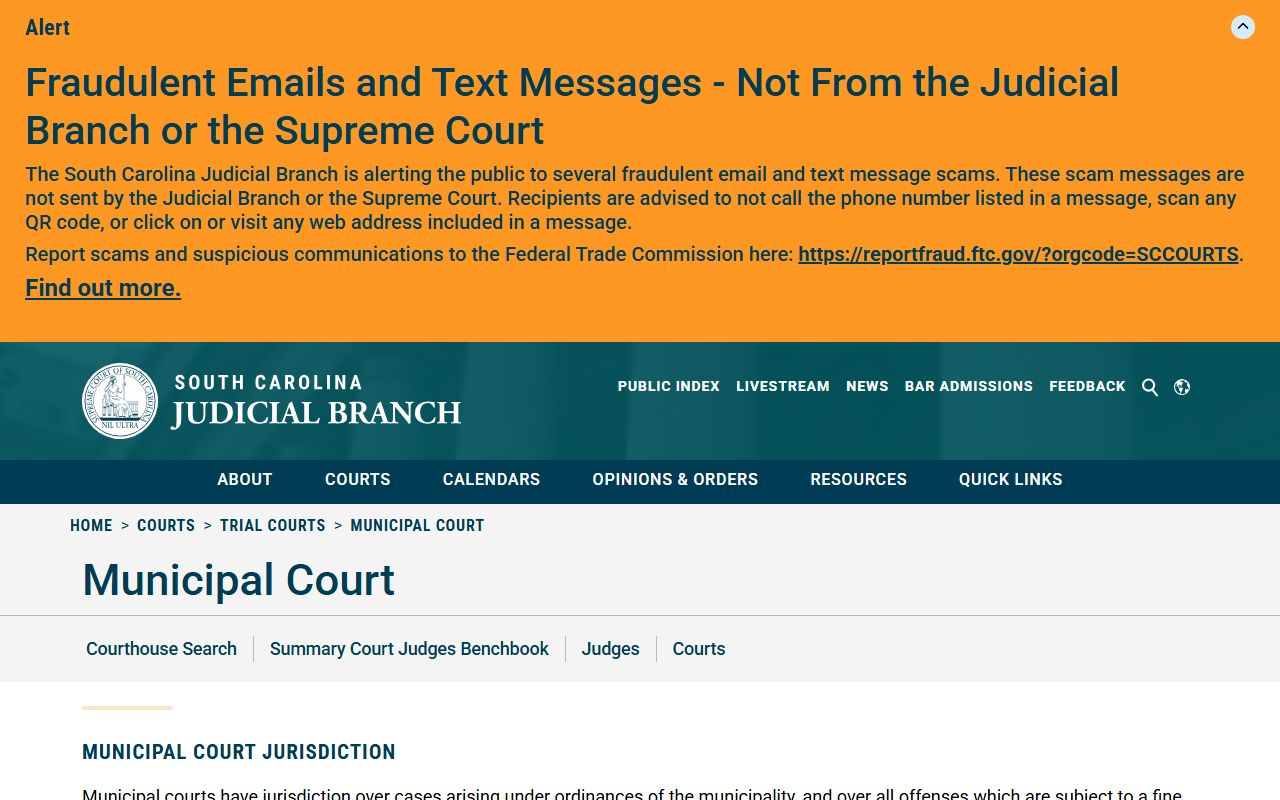
The overview above notes that a municipal court has no civil power and works only within city limits, which keeps it clearly below the Circuit Court.
Greenville County Magistrate Courts and Bond Court
The county runs its own set of summary courts. These are the Gantt, North, South, and West Greenville summary courts, plus a downtown bond court. The bond court at McGee Street handles bond hearings, warrants, and first appearances for people just arrested. The summary courts handle small claims, evictions, and county traffic. The county explains how to choose the right magistrate court by entering an address into a GIS tool.
The county's Magistrate Courts page sets out the civil filing rules and the summary court locations. For the township traffic courts, the right magistrate by address, and the jury rules, see the Greenville County Magistrate Courts page.
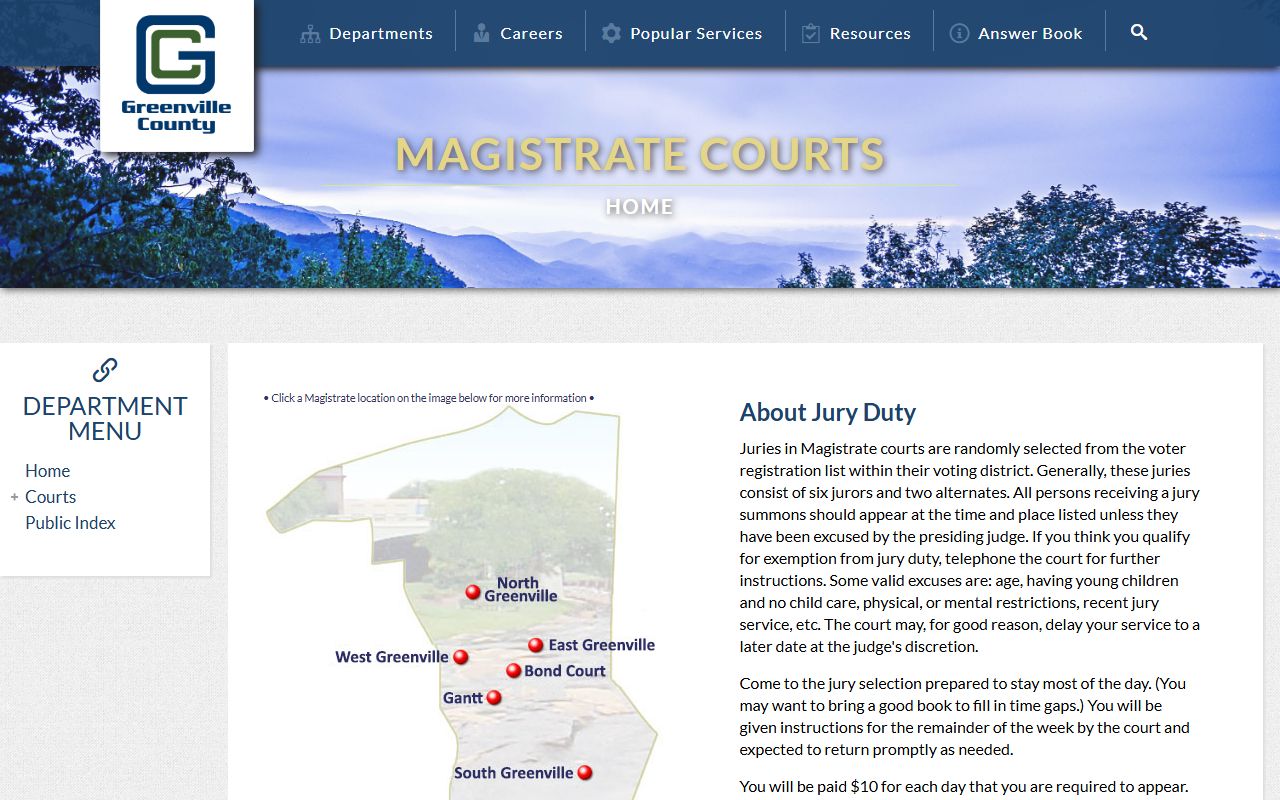
The county page above covers how to pick a summary court and how county traffic tickets are handled. It is the local source for magistrate venue questions.
Circuit Court vs the Federal District Court
One point trips up many searchers. In South Carolina, the state trial court is the Circuit Court, not a "District Court." When you hear "District Court" here, that almost always means the federal court. Greenville County falls within the U.S. District Court for the District of South Carolina. That federal court sits in the Carroll A. Campbell, Jr. United States Courthouse on East North Street in Greenville. It is a separate system with its own judges, clerk, and records.
The federal court hears federal crimes, civil rights claims, federal tax matters, and certain civil suits between parties from different states. State cases like a typical foreclosure, a state felony, or a state lawsuit go through the Greenville County Circuit Court, not the federal court. Federal case records are searched through PACER, and the court's site is at scd.uscourts.gov. Do not request a state Circuit Court file from the federal clerk, or the other way around.
Key Statute:
S.C. Code § 14-5-10 et seq. - Title 14, Chapter 5 is the statutory base for Circuit Court organization, reflected locally through the 13th Judicial Circuit.