
Common Questions About Greenville County Court Records
How do I search Greenville County court records online?
Use the Greenville County Public Index. Open the portal in a browser with cookies and JavaScript turned on. Read the disclaimer and click Accept. Next, enter the security code and click Validate. Then search by name, case number, action type, date range, court type, or party type. The state Judicial Branch also links Greenville from its statewide Case Records Search page. The Public Index is free. For the full step-by-step guide, see the Greenville County court records page.
What is the difference between Common Pleas and General Sessions?
Both are divisions of the South Carolina Circuit Court. Common Pleas is the civil side. It handles lawsuits, foreclosures, judgments, and other civil claims. General Sessions is the criminal side. It handles felony and serious misdemeanor cases. The Clerk of Court keeps records for both. So when you search, you can filter by court type to see one or the other. More on how the trial court is set up is on the Circuit Court page.
Can I see criminal documents online?
Not the full images. General Sessions criminal searches show file information online, but the actual document copies are not posted. You request those from the Criminal Records Department in Suite 228 of the courthouse, or by email. Give the arrest warrant number and the indictment number, and list the documents you want. Civil case images, by contrast, can be printed from the Public Index. The criminal records page walks through the request steps.
What does it cost to get copies from the Clerk?
Copies and printouts are $0.25 per page. A certified or sealed copy is $10 per document. An exemplified copy or a notary certificate under seal is also $10 per document. You can pay by cash, money order, business check, or a credit or debit card with a processing fee. These are copy fees, not filing fees. For the full fee list and how to ask for a copy, see the Clerk of Court page.
Where is the Greenville County Courthouse?
The main courthouse is at 305 East North Street, Greenville, SC 29601. It sits at Church Street and East North Street in downtown Greenville. Family Court is in a separate building at 350 Halton Road. Probate Court is at 301 University Ridge, Suite N-T100. The building you need depends on the case. A civil or criminal matter points downtown. The court records page lists each office address.
How do I find an inmate in Greenville County?
Start at the county inmate search disclaimer page. Accept the terms to reach the inmate search tool. You can look up a person by name and see charges, bond, and booking details. The county warns that the data changes fast and may not show current status. So it is not the official record. For a legal decision, confirm with the Detention Center or the court. The inmate records page explains the search in full.
Does an arrest mean someone was convicted?
No. An arrest is not a conviction. The county's own inmate search disclaimer states that an arrest does not mean the person has been found guilty of a crime. Most people in the jail are pretrial detainees. That means they have been charged but the case is not yet resolved. A charge can be dropped, dismissed, or end in an acquittal. To check a case outcome, search the criminal records on the Public Index.
How do I find an inmate's bond?
Bond shows up through the Inmate Search option. Bonds are listed for each charge. If you see a temporary bond, that means the person has not yet appeared before a judge for arraignment and no bond has been set. So the amount can change once the bond hearing happens. Paying bond is not the same as release. To learn how bond and release timing work, see the inmate records page.
How long does release take after bond is paid?
Paying bond does not finish the release. The jail must first get judicial release authorization. After it has that, the facility's goal is to release the person within four hours. But an emergency or other exigent circumstance at the jail can delay it. So plan for some wait time even after the money is paid. For release timing and how to confirm a release, check the released inmates page.
How do I get an inmate's release date?
You will not find a firm release date on the online tool. The Detention Center FAQ says you must contact or visit the facility to get release-date information. The inmate may also have access to that detail. So the best path is to call the jail or have the inmate share it. The released inmates page covers how release works and what the jail can and cannot tell you.
What inmate information can the jail give me?
Quite a bit, actually. Staff can confirm that a person is in custody. They can give the charges, the warrant, ticket, or case numbers, the arresting officer or agency, the trial magistrate or municipal judge, the bond or sentence amount, and any holds from other agencies. They will not give an account balance to anyone but the inmate. For how this ties to a court file, see the warrant records page.
How many visits can an inmate have?
Adult inmates get two 30-minute visits per week. Up to three adults can be on the visitation list. The list can be updated once every 30 days. A single visit can include one adult and two minor children. So plan the schedule ahead. Rules at the jail change, so confirm before you go. The image and notes on the inmate records page explain visitation and what you can bring.
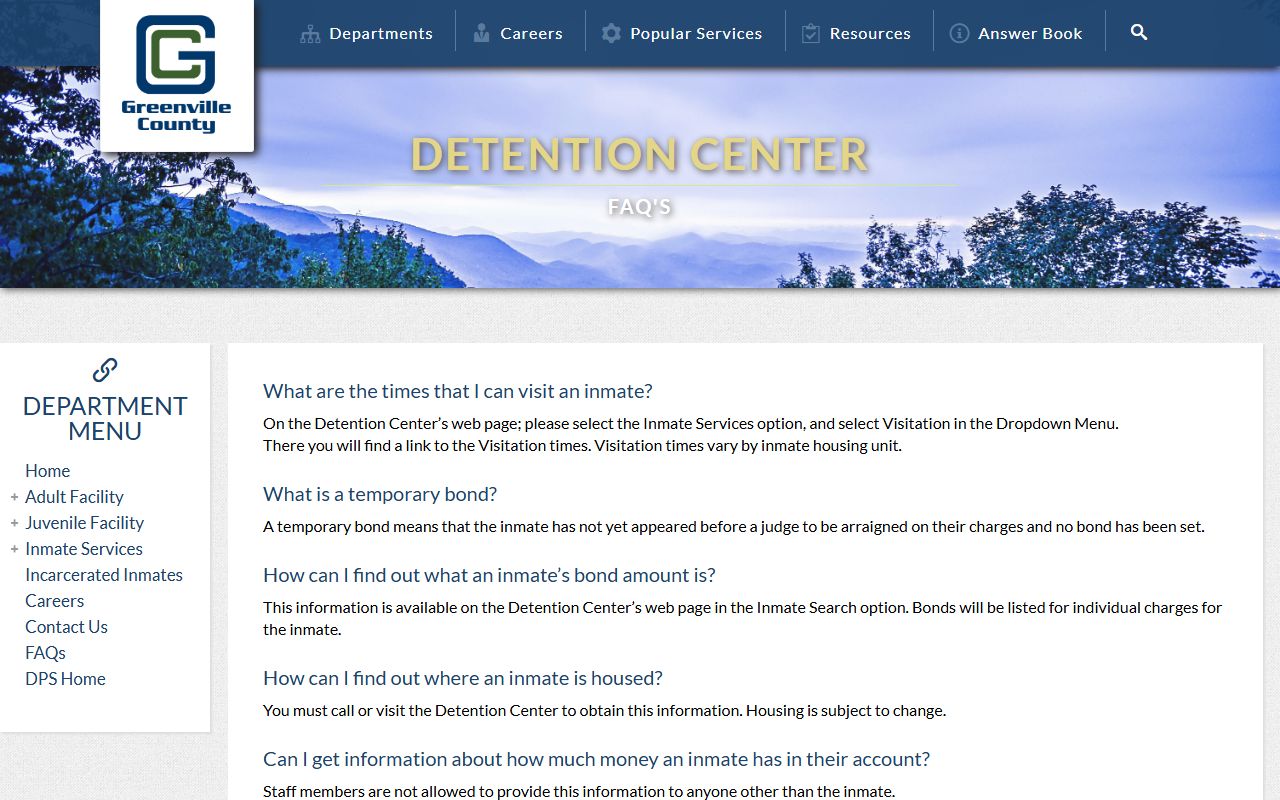
The screenshot below is the county Detention Center FAQ, which covers bond, release, and inmate information.
Greenville County Detention Center FAQ answers many jail questions in one place.
Can I bring my phone to inmate visitation?
No. The Detention Center visitation page bans cell phones, cameras, purses, and bags. It also bans tobacco, lighters, flame-producing devices, mace, chemical sprays, firearms, and weapons. So leave those items in your car. Bring only what the jail allows. Check the current list before you arrive, since rules can shift. The inmate records page links the visitation rules and other jail policies you should know first.
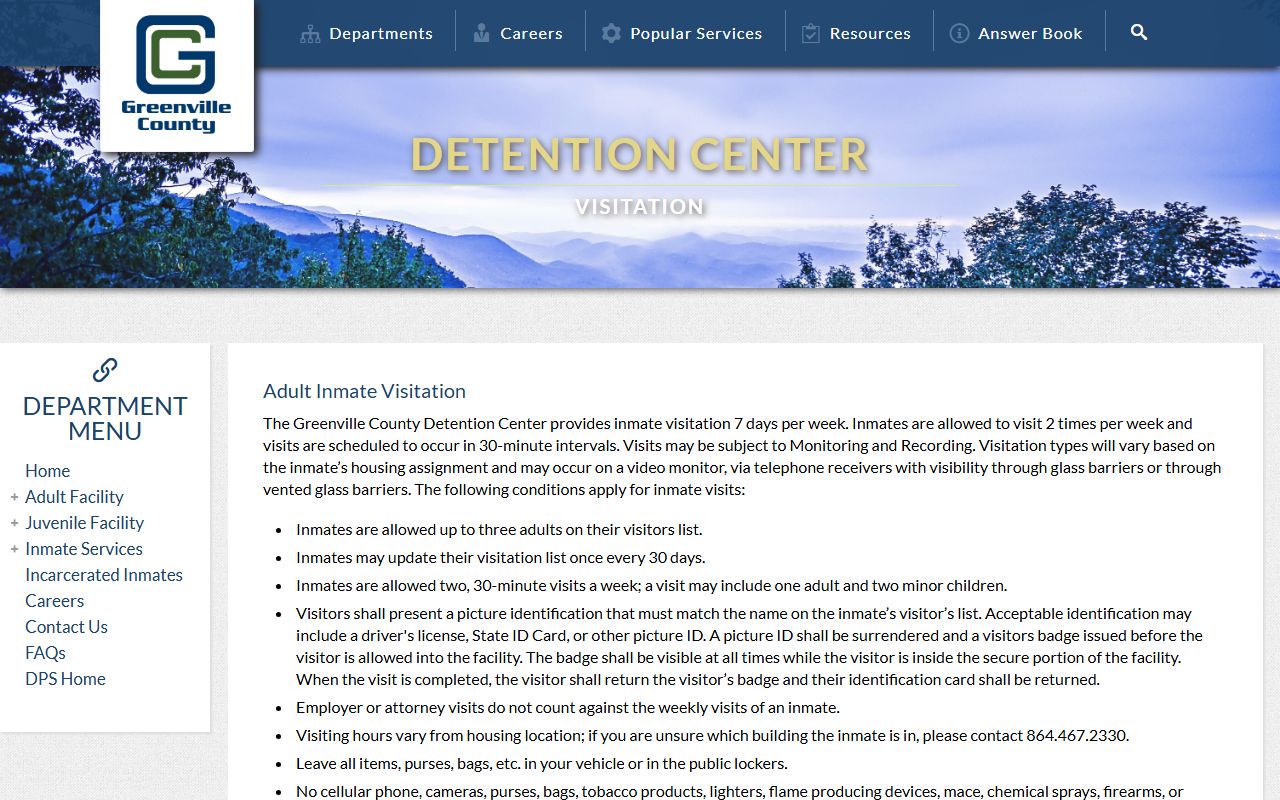
The next image shows the county's inmate visitation page with the full rules.
The Greenville County inmate visitation page lists schedules and banned items.
Where do I apply for a marriage license?
You apply at Greenville County Probate Court, not the Clerk of Court. The Marriage License Division is at 301 University Ridge, Suite N-T100. You can apply online or in person. South Carolina has a 24-hour wait between the application and issuance, so do not leave it to the last day. Probate suggests starting about two weeks before the ceremony. The marriage and divorce records page lists the fees and steps.
Where are divorce records?
Divorce is a Family Court matter. The Greenville Family Court is at 350 Halton Road. Older Family Court records from 1925 through April 1996 are held at the Clerk's Circuit Court office downtown. Records after that date are at the Family Court office. So the age of the case decides where the file sits. To search and request divorce files, see the Family Court page and the marriage and divorce records page.
Are juvenile records public?
Generally no. The Clerk lists juvenile cases as an exception to public viewing and copying. South Carolina also has a separate juvenile expungement process that runs through the solicitor, DJJ, SLED, and Family Court. So you cannot simply ask the clerk to print a juvenile file. A judge controls access. Adoption files and sealed cases are closed too. The public records page explains which records stay restricted and why.
Where do traffic tickets go?
It depends on who wrote the ticket. County Magistrate Court hears many Sheriff and Highway Patrol traffic cases, split across the East Greenville, North Greenville, Fairview Austin, and West Greenville Township courts. City tickets go to the municipal court for that city. You can often pay online with the citation number and last name. Magistrate courts take money orders, certified checks, or cash, but not personal checks. See the traffic court records page for details.
How do I search probate records?
Use Greenville Probate's Estate Search. You reach it through the county public-records disclaimer page. Marriage license records have their own search link. Attorneys may use a separate case management system. Probate handles estates, wills, guardianships, conservatorships, and involuntary commitments. Some of those, like commitment files, are highly restricted. For the estate search steps and the common terms used in these files, see the probate records page.
How much can I sue for in Magistrate Court?
Up to $7,500. South Carolina magistrates have civil jurisdiction when the amount in dispute does not top that limit. Greenville's Magistrate page confirms that summons and complaint actions can be filed there as long as the claim is no more than $7,500. To find the right court, you enter the relevant address in the county's GIS tool. The Magistrate Courts page explains which address to use for each kind of case.
Is the jail's inmate search an official court record?
No. The inmate search disclaimer says nothing on the site is an official county record, and the official records stay in the respective offices. So treat the inmate search as a quick, current snapshot, not proof. After you find a person, confirm the court facts through the Public Index, the Clerk, the court of jurisdiction, or the Detention Center. The county also notes the data can lag. For population counts and trends, see the jail population data page.
Can courthouse staff give legal advice?
No. The Clerk page is clear that judges and court staff cannot give legal advice. They can show you where forms and rules are, but they cannot tell you what to do in your case. For help, use the SC Bar Lawyer Referral Service, South Carolina Legal Services, LawHelp SC, or hire an attorney. A lawyer is wise when the matter is sealed, juvenile, or confidential by statute. More access basics are on the public records page.
Still Have Questions?
For the right office, see the Clerk of Court. For broader access rules, see public records. For records by topic, browse court records, criminal records, inmate records, warrant records, marriage and divorce, or probate.