
Arrest Records in Greenville County
An arrest record is made by law enforcement, not the court. In Greenville County, the Greenville County Sheriff's Office and city police agencies make arrests. The person is then booked into the county Adult Detention Center on McGee Street. The booking file lists the charge, the warrant or ticket number, the arresting officer and agency, and the bond status. Sheriff Hobart Lewis leads the office that runs the jail. Most people held there are pretrial detainees, which means they have been charged but not yet tried.
An arrest record is not the same as a criminal court record, and neither one is a conviction. The arrest record shows that a person was taken into custody. The court file shows what happened after charges were filed. A conviction is the final finding of guilt. Greenville County arrest data is a starting point, not proof of guilt. For the full case history that follows an arrest, see the Greenville County court records page.
How to Search Greenville County Arrest Records
The fastest way to find a recent arrest is the county inmate search. It shows people currently in custody at the Detention Center. The county posts a disclaimer first, and you must accept it before you reach the search tool. The data changes fast and is not the official record. For someone already booked, the search can confirm the charge, the warrant or case number, the arresting agency, and the bond amount tied to each charge.
- Open the county inmate search disclaimer and read the terms.
- Click Accept to reach the inmate search portal.
- Search by name to look up a person in custody.
- Open a result to view the charge, bond, warrant or case number, and arresting agency.
An arrest that led to a filed charge will also show on the court side. The Greenville County Public Index lets you search General Sessions criminal cases by name or case number. On the Public Index, the arrest warrant number is shown as the case number. For people who are no longer in the jail, see the released inmates page.
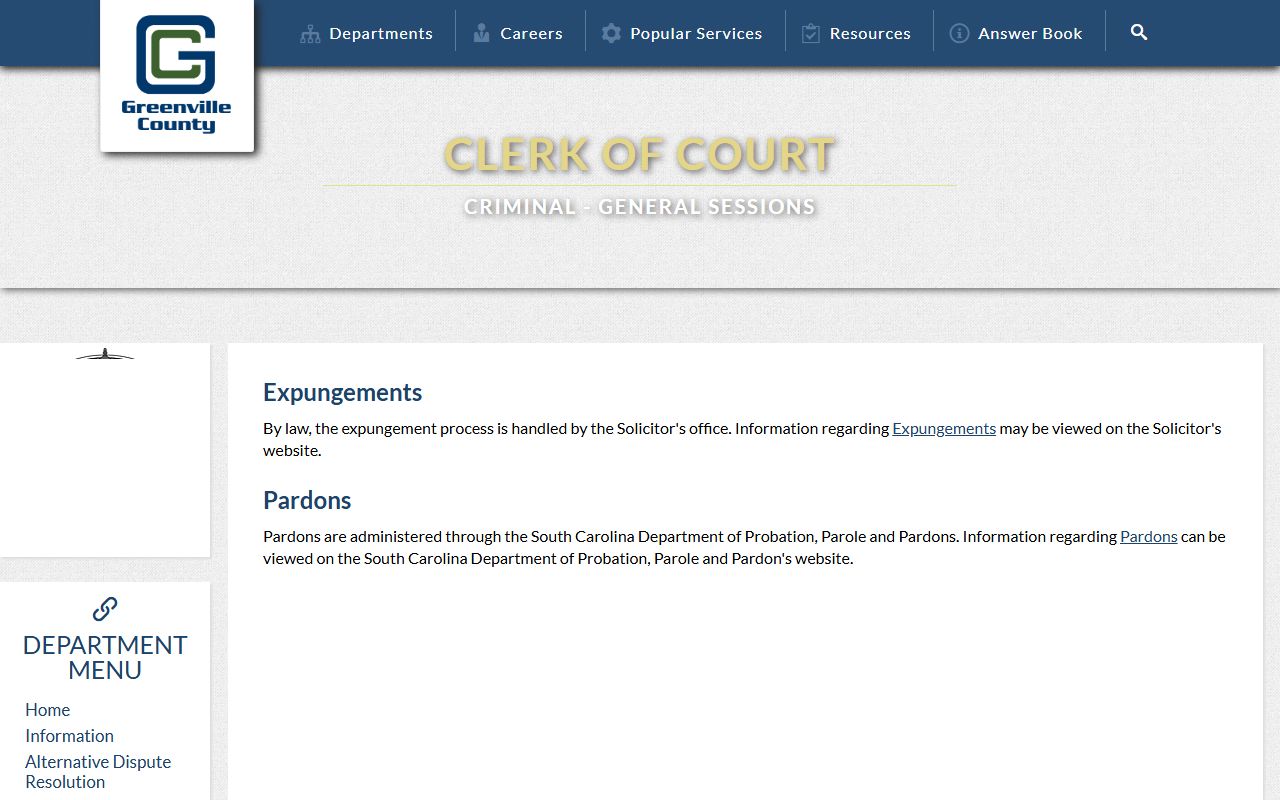
The Clerk's expungements and pardons page shown above explains how eligible arrest and charge records can be removed, which matters when a search turns up an old case.
Arrest Record vs Criminal Court Record
These two records come from different offices and start at different times. The arrest record is born at booking, when the sheriff or police log the charge. The criminal court record starts later, when the 13th Circuit Solicitor files charges in General Sessions. One is a law enforcement file. The other is a court file. The chart below sets them side by side.
| Arrest Record | Criminal Court Record | |
|---|---|---|
| Source | Sheriff / Police | Clerk of Court |
| Created When | Booking at the jail | Charges filed in General Sessions |
| Contents | Booking info, charge, bond, arresting agency | Indictment, pleas, motions, disposition, sentence |
| Where to Find It | County inmate search | Public Index and Clerk |
Note: The inmate search reflects custody at the jail, while the court file follows the case even after release, so check both when you trace an arrest.
Charges vs Convictions
Being charged is not the same as being found guilty. A charge is an accusation. It means the state believes there is enough cause to bring the case. A conviction is the end result, either a plea or a verdict. Many charges are later dropped, dismissed, or reduced. The county's own inmate disclaimer says plainly that an arrest does not mean the person was convicted. Read every arrest record with that in mind.
| Charge | Conviction | |
|---|---|---|
| Stage | Accusation | Verdict or plea |
| Burden of Proof | Probable cause | Beyond reasonable doubt |
| Public Record | Yes | Yes |
| Final? | No, may be dropped or reduced | Yes, unless appealed |
Bond and Magistrate Court After Arrest
After a booking, the next step is bond. A magistrate sets the bond at a bond hearing, often within hours of the arrest. The bond amount is listed by charge in the inmate search. A temporary bond means the person has not yet seen a judge for arraignment and no bond has been set. Some people are released on personal recognizance, which is a promise to appear. Others are held with no bond until a judge changes it.
Bond Court and the city magistrate handle these early steps in Greenville County. The county lists Bond Court at 4 McGee Street, near the Detention Center. Paying a bond does not finish a release. The jail still needs a judicial release order before the person can leave. For warrants that drive an arrest, and how a warrant number ties to a case, see the Greenville County warrant records page.
Requesting Criminal Records From the Clerk
The Public Index shows criminal file information online, but it does not hand you the actual documents. For copies of General Sessions papers, you ask the Clerk of Court. The county Criminal Records Department sits in Suite 228 of the courthouse at 305 East North Street. You can request copies in person or by email at coccriminalrecords@greenvillecounty.org. Give the arrest warrant number, the indictment number, and a list of the documents you want.
Copy fees are set. A plain copy is a quarter a page. A certified copy under seal is ten dollars per document. The Clerk does not keep Magistrate, Municipal, or State Grand Jury records, so those copies come from those courts instead. More request detail is on the Clerk of Court page.
Sealed vs Expunged Records
Sealing and expungement both limit public access, but they are not the same. A sealed record stays in court control and is hidden from public view, though some agencies keep limited access. An expunged record is removed or destroyed and is treated as if it never happened. South Carolina sets clear rules for both. Expungement eligibility is governed by Title 17, Chapter 22 and Title 22, Chapter 5 of the state code.
| Sealed | Expunged | |
|---|---|---|
| Visibility | Hidden from public | Destroyed or treated as never existed |
| Law Enforcement | Limited access | Very limited, only where statute allows |
| How It Happens | Judge's order | Statutory eligibility and court order |
| Eligibility | Set by the court | Nonconvictions, diversion, first-offense, youthful offender |
The uniform expungement procedures are shown on the South Carolina state code site below. The image gives the official statute text behind the 13th Circuit Solicitor's expungement process.
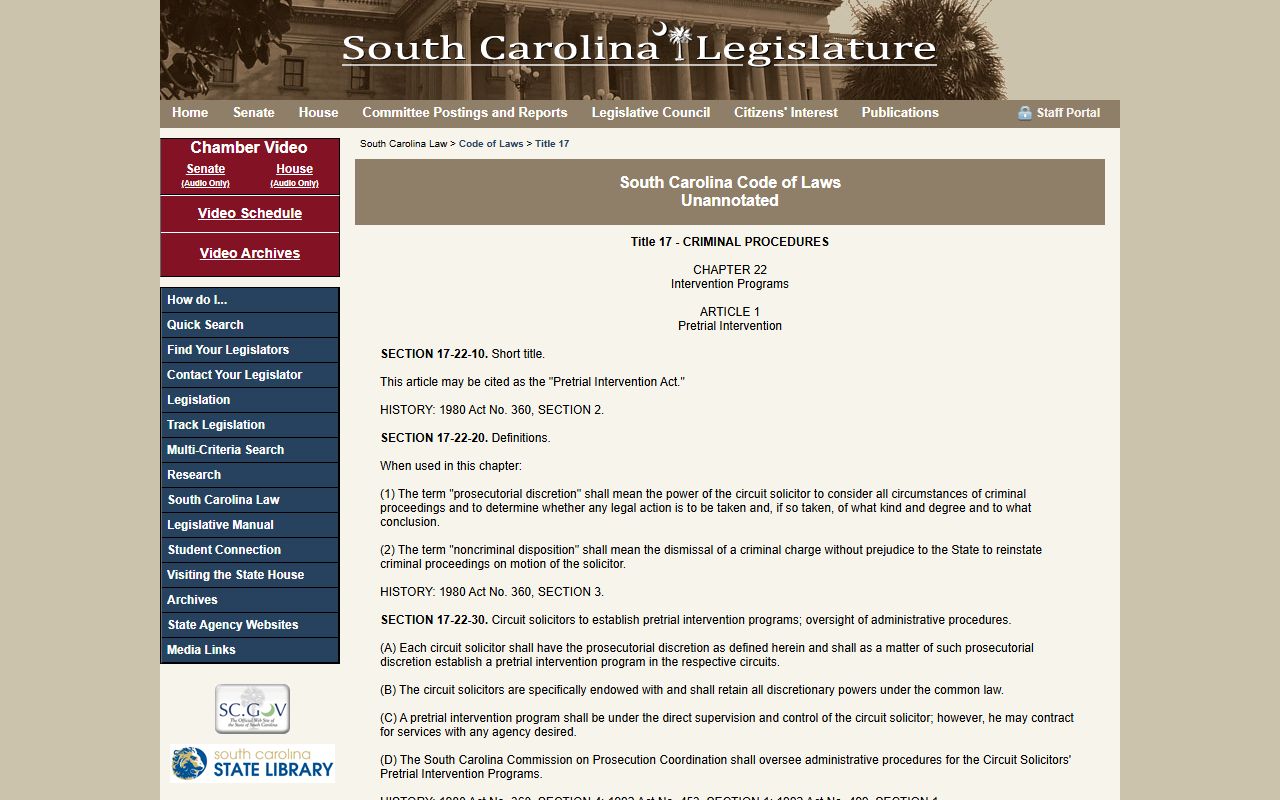
That page sets the solicitor administrative fee and the steps that route an eligible Greenville County record through SLED and the courts. Summary-court first-offense expungement is covered under S.C. Code Title 22, Chapter 5.
Restricted Criminal Records in Greenville County
Not every arrest record is open. The Clerk lists clear exceptions to public viewing and copying. Dismissed warrants are excluded. Sealed cases are closed by court order. Adoption filings are restricted. Juvenile records get the strongest protection of all. Juvenile justice files are not treated like adult criminal records, and the state runs a separate juvenile expungement process.
Juvenile records confidentiality comes from S.C. Code Title 63, Chapter 19. The state Judicial Branch also runs a dedicated juvenile expungement process, shown below, that involves the solicitor, the Department of Juvenile Justice, SLED, and a family court judge.
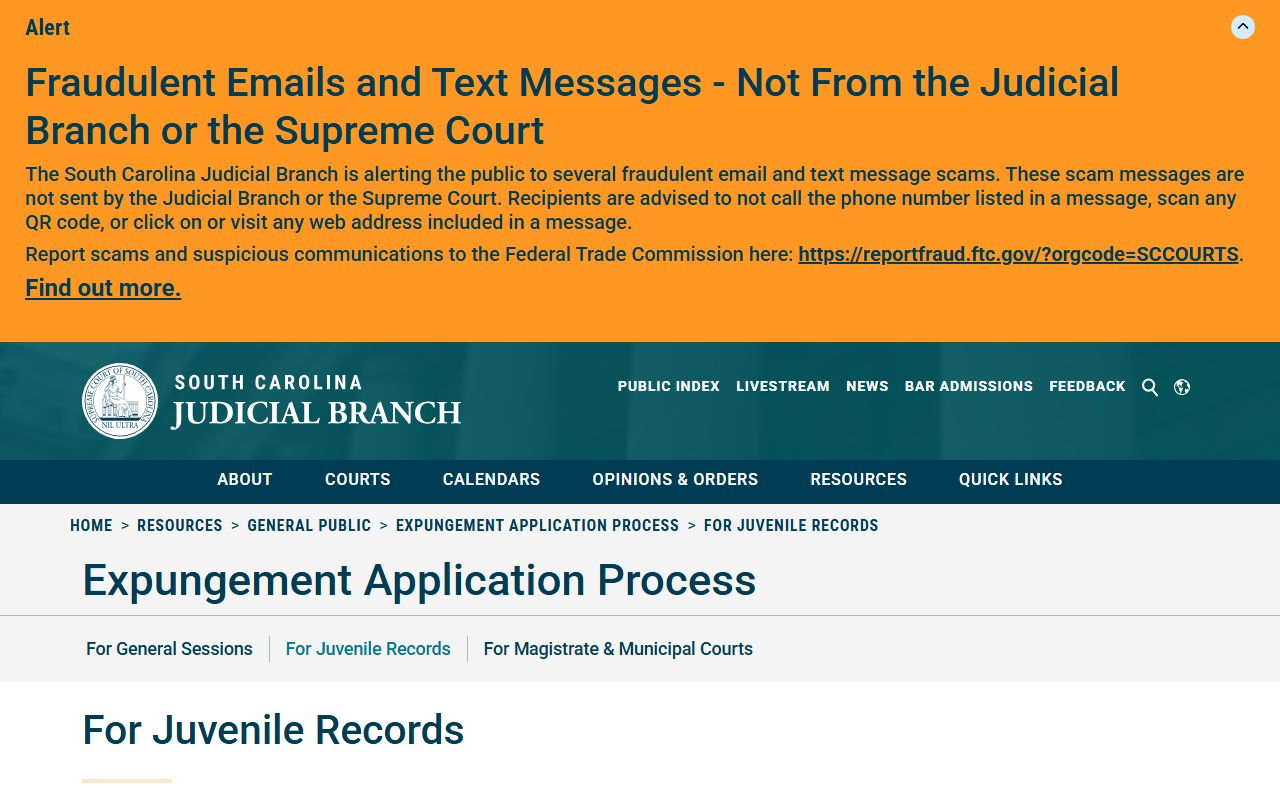
The follow-up image confirms the juvenile route is separate, which is why a juvenile arrest may not appear on a public search at all.
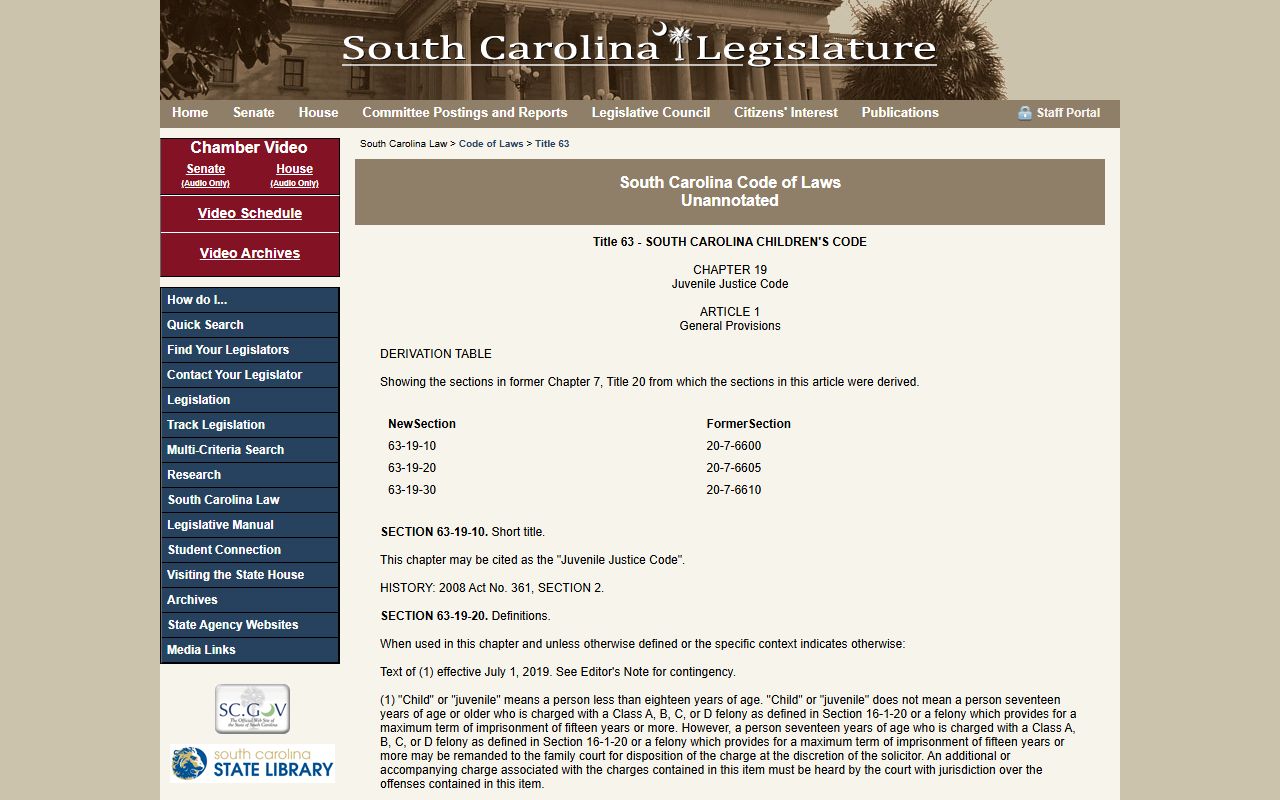
The statute text above is the legal basis for keeping juvenile arrest and court files out of the public index.
Solicitor and Public Defender
After an arrest, two offices shape the case. The 13th Circuit Solicitor prosecutes General Sessions cases for Greenville and Pickens Counties. It is the largest Solicitor's Office in the state. The office includes assistant solicitors, legal investigators, and victim advocates, and it runs a Domestic Violence Unit. The Solicitor, not the victim, controls whether a case moves forward once charges are filed.
People who cannot afford a lawyer may qualify for the Public Defender. The 13th Circuit Public Defender Office represents eligible adults and juveniles charged in the criminal courts of both counties. The image below shows the Public Defender's site.
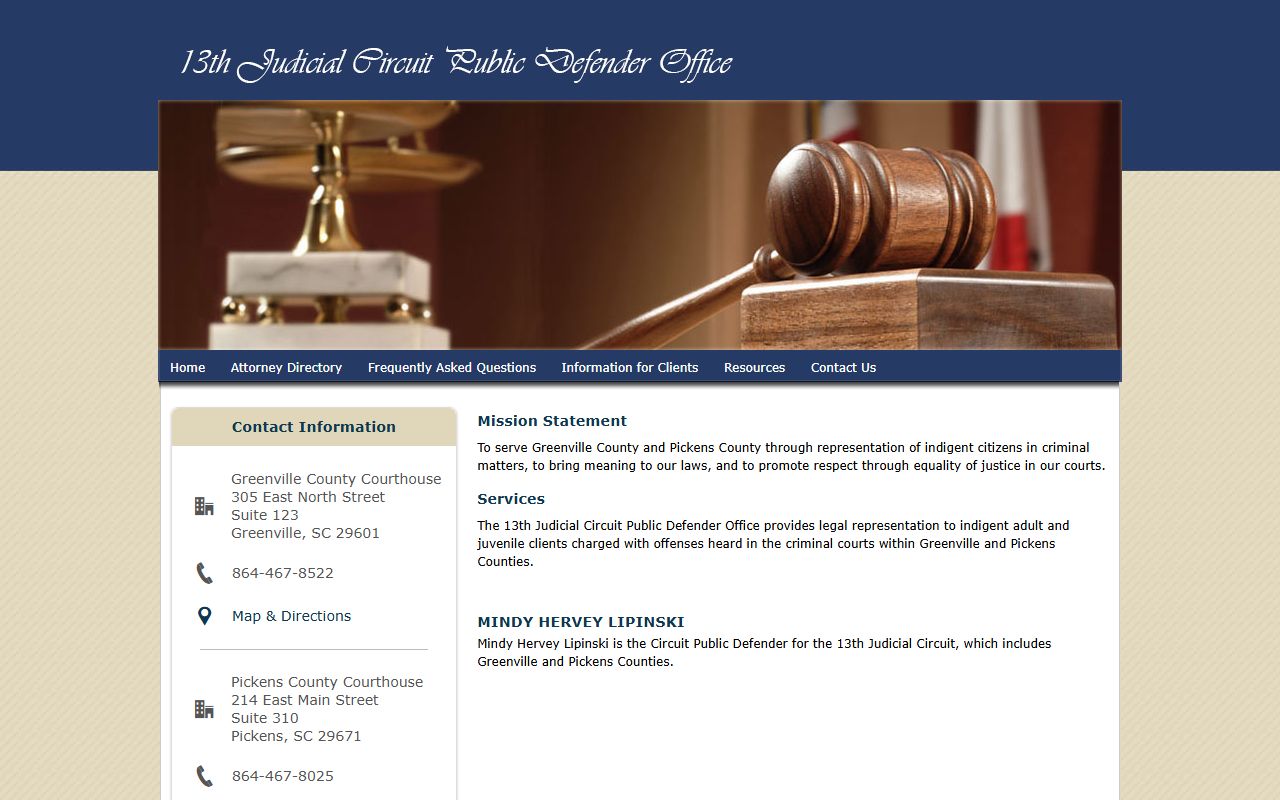
That office handles indigent defense, though eligibility is not automatic just because a person asks for it.
Background Check Considerations
People often confuse a casual arrest lookup with a formal background check. They are not the same. A background check used for hiring, housing, or credit must follow the federal Fair Credit Reporting Act. A quick search of public arrest data does not meet that standard. Use the right official source for any decision that affects a person's job or home.
Important: This is a private resource, not a consumer reporting agency under the FCRA, so do not use it for credit, employment, tenant, or insurance screening.