
What Probate Covers in Greenville County
The Greenville County Probate Court handles estates, wills, and the appointment of personal representatives after a death. It also oversees guardianship and conservatorship for adults or minors, protective proceedings, and involuntary mental-health commitments. Marriage licenses come from this same court. So the work ranges from settling an estate to issuing a license to wed. Judge Chadwicke L. Groover leads the court, which sits in Greenville County Square.
Probate Court is a county court under South Carolina law. The S.C. Code Title 14, Chapter 23 establishes probate courts and probate judges across the state. So the local estate, marriage, guardianship, and commitment functions all sit within that statutory frame. Circuit Court holds limited appellate review over Probate Court decisions.
The image below shows the county Probate estate division page.
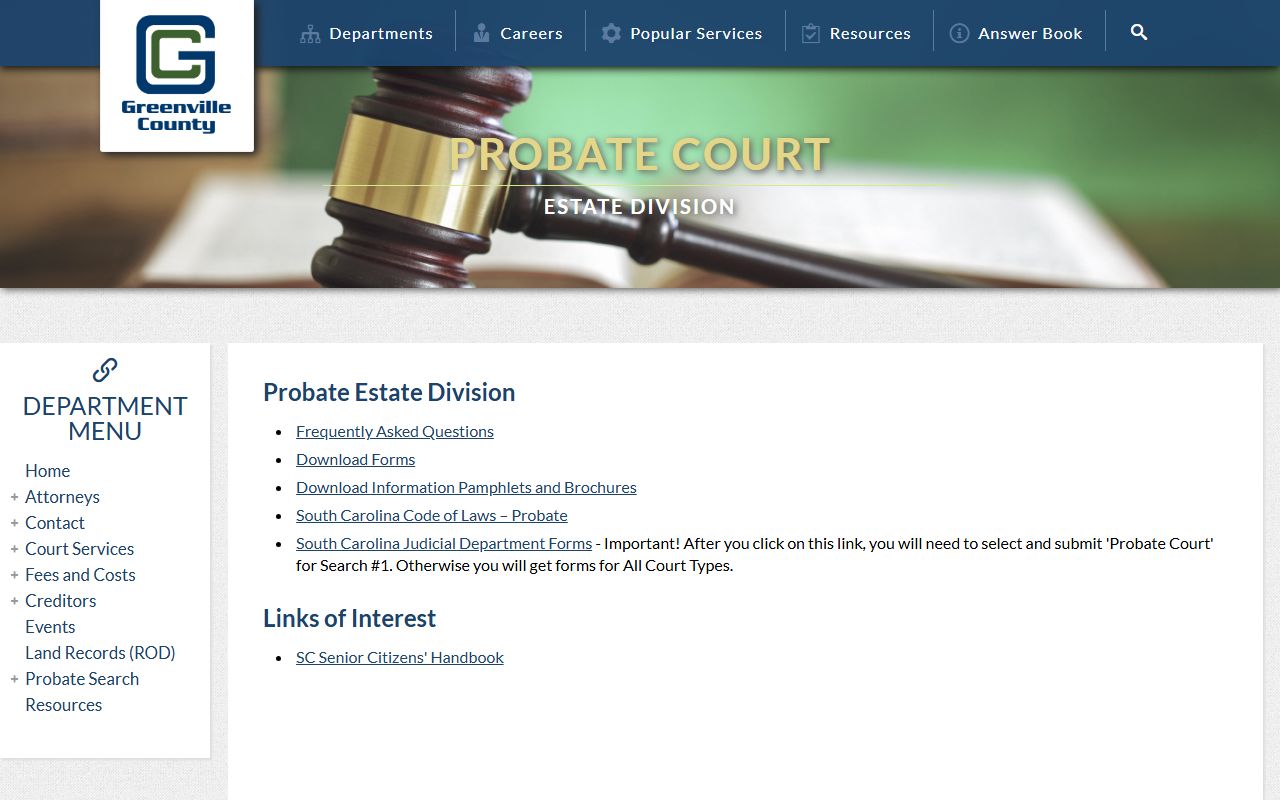
That page links the estate forms, creditor claim forms, and the copy request used for probate records.
Greenville County Probate Terms Defined
Greenville County probate files use words that confuse many first-time readers. A short guide helps before you search. The terms below come up in nearly every estate or protective case.
- Testator
- A person who makes and leaves a valid will.
- Executor
- The person named in a will to carry it out and settle the estate.
- Personal Representative
- The person the court authorizes to administer an estate, whether or not there is a will.
- Intestate
- Dying without a valid will, so state law decides who inherits.
- Guardianship
- A court appointment to make personal or care decisions for someone who cannot.
- Conservatorship
- A court appointment to manage the money and property of a person who cannot.
How to Search Greenville County Probate Records
Greenville County runs a Probate Estate Search behind a public-records disclaimer page. A separate Marriage License Search sits behind its own disclaimer page. You accept the terms first, then search by name or case number. For older or genealogical material, the court keeps a historical records search. Attorneys use a separate Attorney Case Management System for their cases.
- Open the county probate estate search and read the public-records disclaimer.
- Click to accept the disclaimer and enter the search tool.
- Search by an estate or party name, or by a case number, then open the matching file.
The screenshot below shows the probate estate search entry.
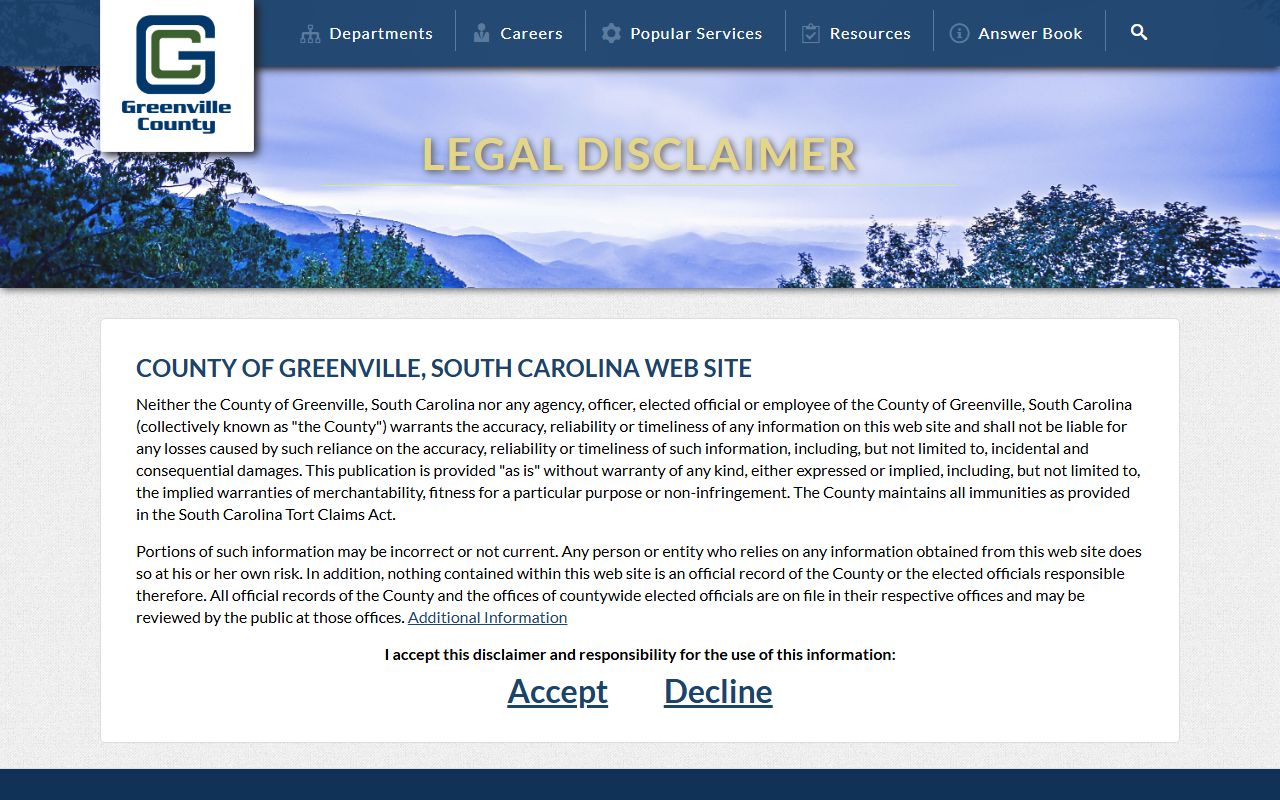
That page is the gate to the estate index. Exact search controls show only after you accept the disclaimer in a live browser.
Greenville County Probate Court Contact
The Probate Court sits in Greenville County Square at 301 University Ridge. The marriage division uses Suite N-T100, and the judge's office is listed at Suite 1200. Use the contact card below to reach the court directly. Note: Court staff can give filing, fee, and copy information, but they cannot give legal advice or prepare your papers for you.
Greenville County Probate Court
301 University Ridge, Suite N-T100 / 1200
Greenville, SC 29601
864-467-7170
Judge Chadwicke L. Groover
Probate Fees in Greenville County
Greenville County probate fees are not the same as Clerk of Court copy fees. Estate filing costs depend on the type of case and the value of the estate, and they follow the county Probate fee schedule. The court publishes a fee schedule PDF with those amounts. Certified copy fees for marriage and probate records are set, and older records cost a bit more.
| Item | Amount |
|---|---|
| Estate filing fees | Vary by estate value, per the county Probate fee schedule |
| Certified copy | $5.00 plus $0.50 per page |
| Plain copies | $0.50 per page |
| Certified marriage copy, years 1911-1970 | $6.00 |
| Certified marriage copy, years 1971-present | $5.50 |
Estate filing fees scale with the value of the estate, so check the current Probate Court fee schedule before you file. Do not rely on a guess.
The Greenville County Estate Process
Greenville County estate administration follows a set path under the South Carolina Probate Code. Some small estates use a simpler procedure. The basic steps run from opening the estate to closing it. Each step has its own forms and deadlines.
- Decide if the estate needs formal probate or a small-estate procedure under state law.
- File the application or petition, plus the original will if one exists.
- The court appoints a personal representative or otherwise authorizes the administration.
- Notify heirs, devisees, and creditors as the law requires.
- Inventory the assets and address any creditor claims.
- Pay approved debts, expenses, and taxes.
- Distribute what remains and file the closing documents and final accounting.
Some estates take longer than others. A missing or contested will, unknown heirs, creditor disputes, a real estate sale, or out-of-state property can all slow things down. A contested estate may need an attorney.
What Greenville County Probate Records Show
A Greenville County estate file is built from many documents added over the life of the case. It can hold the petition or application, the will if one was filed, a reference to the death certificate, and the order appointing a personal representative. You may also find a bond or waiver, an inventory of assets, creditor claim filings, required notices, accountings, and the closing documents.
Marriage license records show the application, the issued license, and the officiant's return after the ceremony. Guardianship and conservatorship files may include medical or capacity information, so they are not fully open. The court also links creditor claim forms, such as a Statement of Creditor's Claim and a Release or Satisfaction of Claim.
Restricted Probate Records
Most estate records are public, but some probate matters are closed or limited. Involuntary commitment proceedings deal with mental-health care and sensitive medical data. Those records are highly restricted and are not open like a normal estate file. Guardianship and conservatorship files can include medical and capacity information, so parts may be shielded even when the case is otherwise viewable.
The image below shows the county page on protective proceedings.
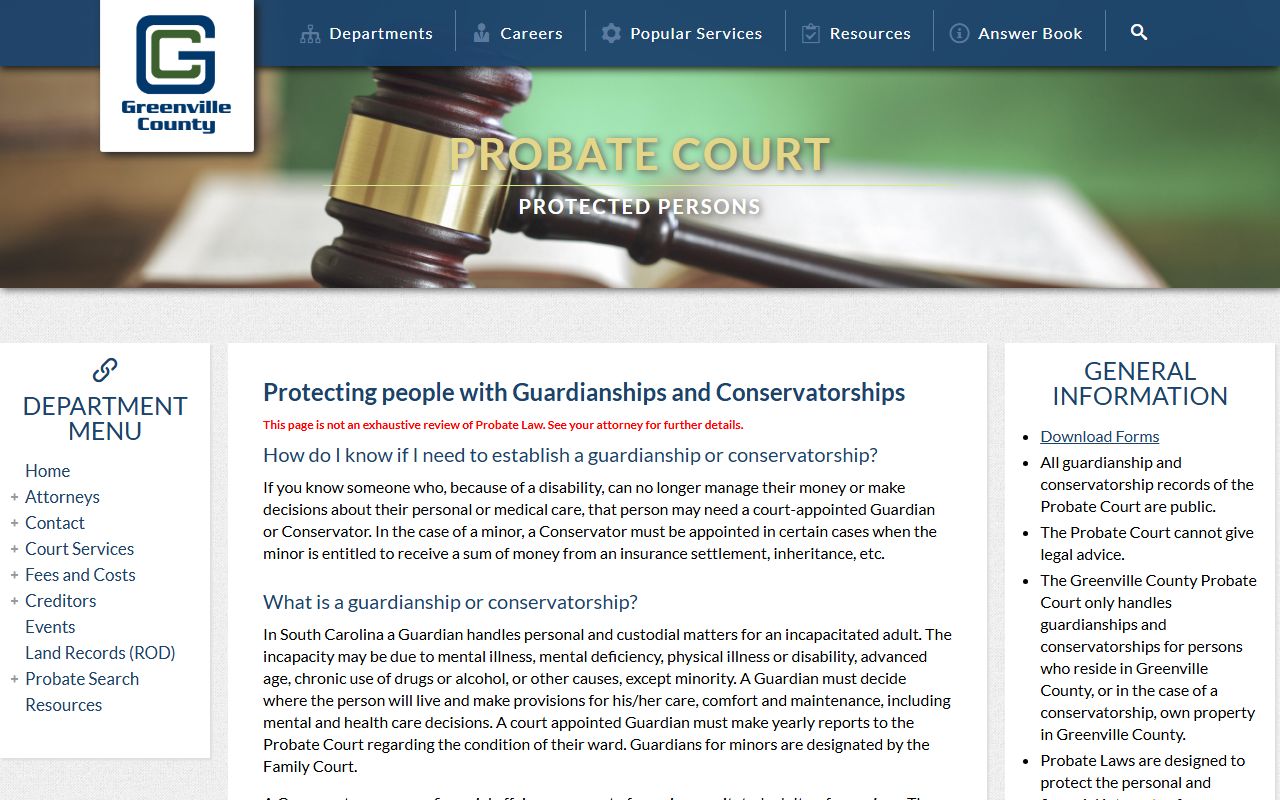
That page covers guardianship, conservatorship, and the protective steps the court can order. The statute that frames the court is shown below.
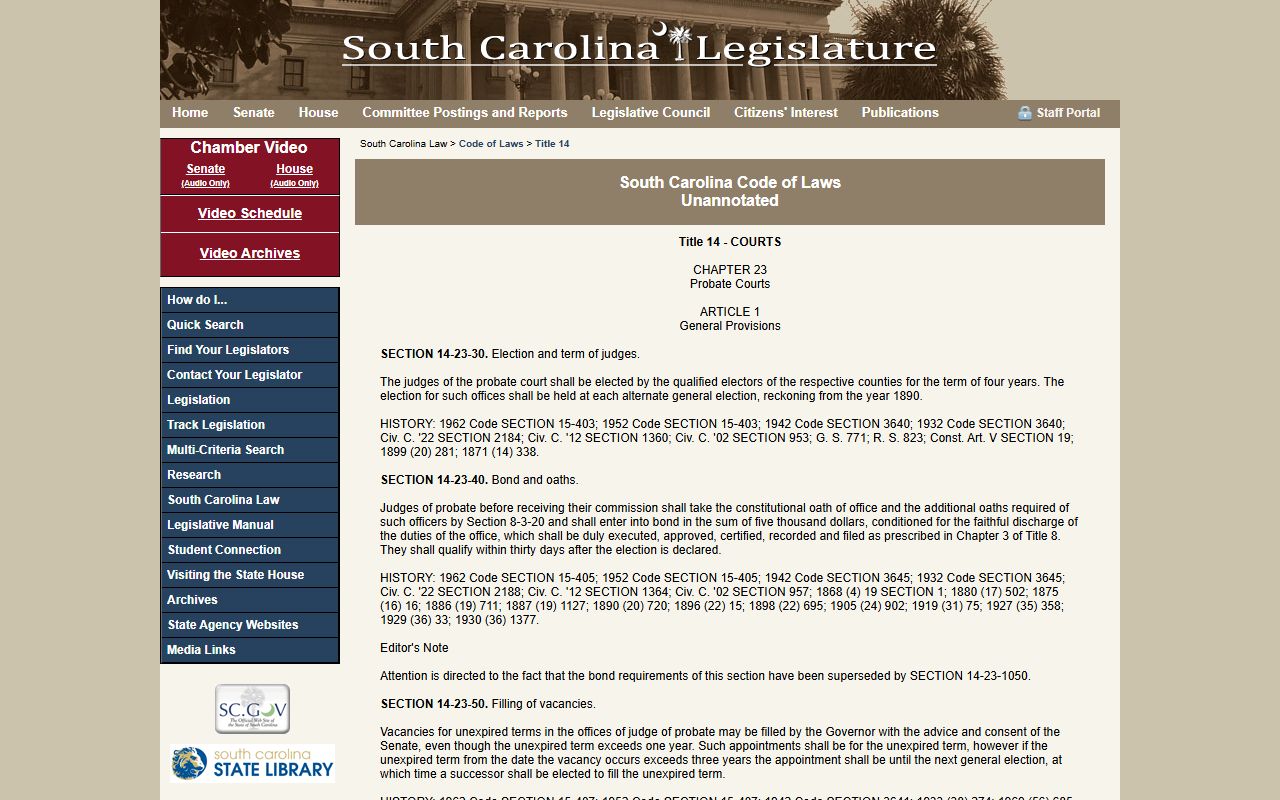
The S.C. Code § 14-23-10 and the sections that follow set up the probate court and the judge's authority over these matters.
Requesting Greenville County Probate Copies
To get a copy of a Greenville County probate record, the court uses a copy request form. You give your name and contact details, the case or estate name, the case number, the document type, and whether you want it certified. You also pick a delivery method and pay the fee. A certified copy carries the court seal and is the kind you need for legal use. A plain printout is not certified proof.
The Probate Court also publishes a range of forms beyond the copy request. The estate side has petitions, inventories, accountings, and creditor claim forms. The protective side has guardianship and conservatorship forms, plus a health care power of attorney and a living will. Pick the form that matches your matter, since the wrong form can stall a filing.
Greenville County Guardianship and Conservatorship
Not every probate case follows a death. Greenville County Probate Court also hears protective proceedings for adults or minors who cannot manage their own care or money. A guardianship lets the court name someone to make personal and care choices for a person who cannot. A conservatorship names someone to manage that person's finances and property. The two can run together or apart, depending on the need.
These files are not fully open. Because they hold medical and capacity information, parts may be shielded even when the case is otherwise viewable. The court reviews evidence about the person's condition before it appoints a guardian or conservator. A minor's guardianship can also arise when a parent dies or cannot serve. For records, the same copy request and fee rules apply, though sensitive details may be withheld.
Greenville County Commitment Records
The Greenville County Probate Court handles involuntary mental-health commitment proceedings. These are not criminal cases. They involve an emergency admission and a judicial review of whether a person needs treatment. The records hold sensitive medical information, so they are highly restricted. They are not open to the public the way a normal estate file is.
Health privacy law shields this material. Only the subject, counsel, the court, medical providers, and other authorized persons may access it. So if you are looking for a commitment record, expect the court to limit what it can release without proper authority.